

Table Of Contents
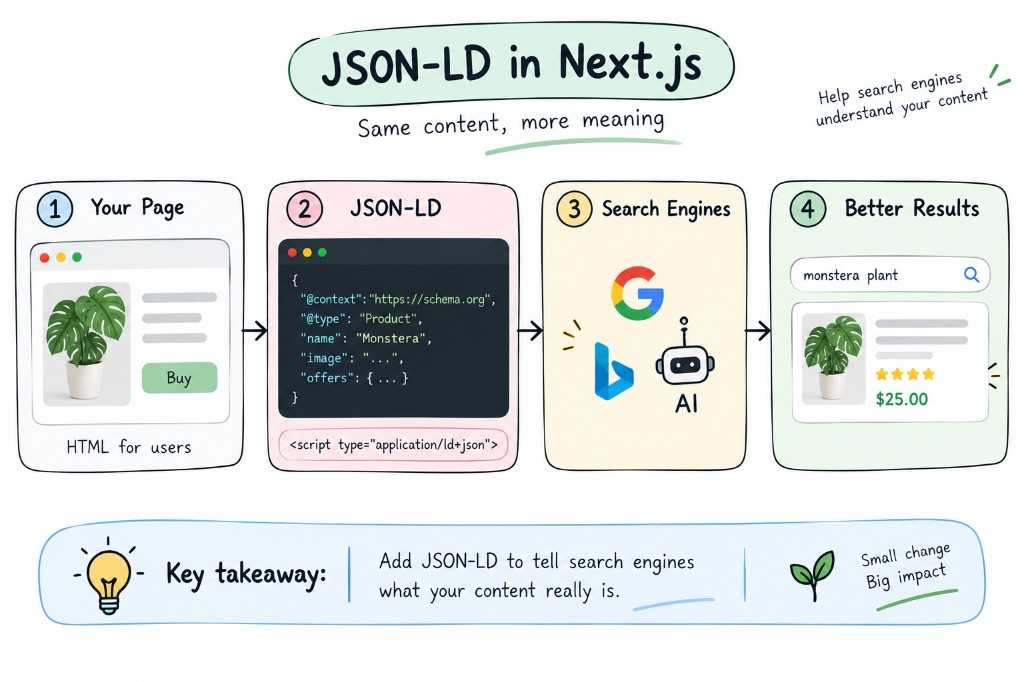
1. What is JSON-LD?
JSON-LD stands for JSON for Linked Data.
It is a format for adding structured data to a webpage so search engines and other systems can better understand the content.
For example, a normal HTML page might contain:
<h1>Monstera Thai Constellation</h1><p>Beautiful variegated plant.</p>
To a user, this is obviously a product.
With JSON-LD, we can explicitly describe it as a Product:
{"@context": "https://schema.org","@type": "Product","name": "Monstera Thai Constellation","description": "Beautiful variegated plant."}
When to use: Use JSON-LD when you want to provide structured information about entities such as products, organizations, articles, events, recipes, and more.
2. @context
@context tells the parser which vocabulary you’re using.
Most websites use Schema.org:
{"@context": "https://schema.org"}
Think of it as:
@context↓"What vocabulary do these properties belong to?"
3. @type
@type tells search engines what the entity is.
{"@context": "https://schema.org","@type": "Product"}
This means:
This data describes a Product.
Common types include:
ProductOrganizationWebSiteArticlePersonEventRecipeBookBreadcrumbList
For example:
{"@context": "https://schema.org","@type": "Organization","name": "Green Garden"}
4. Properties
After defining the type, we provide information about that entity.
{"@context": "https://schema.org","@type": "Product","name": "Monstera Thai Constellation","description": "A beautiful variegated Monstera.","image": "https://example.com/monstera.jpg"}
Here:
@type → Productname → Product namedescription → Product descriptionimage → Product image
Each Schema.org type has its own supported properties.