


Table Of Contents
If you’re learning React, you may soon hear about Next.js. They are related, but they are not the same thing.
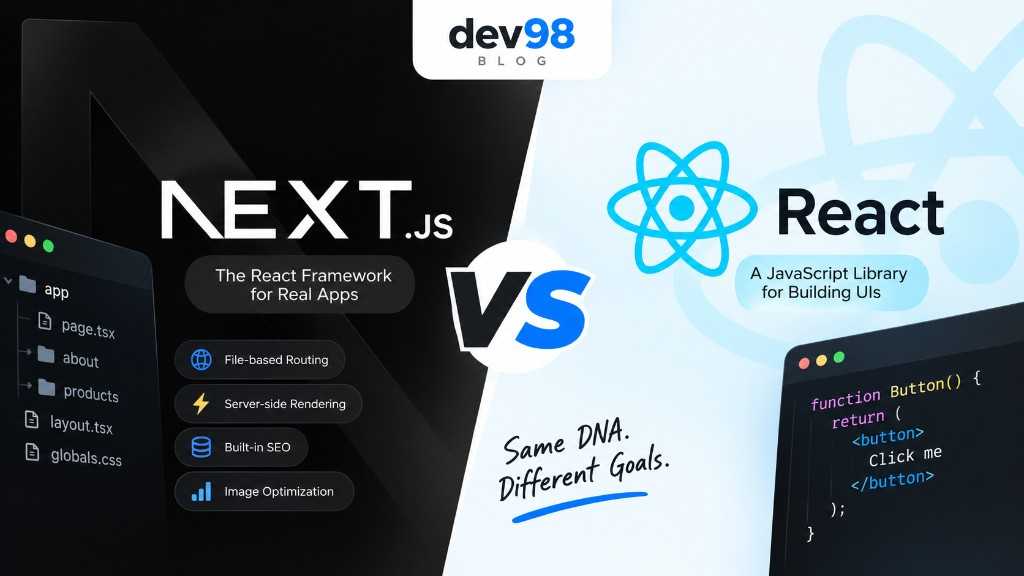
The simple way to remember it:
React is a library for building UI. Next.js is a framework built on React.
Let’s look at the difference in a simple way.
1. What is React?
React is a JavaScript library created by Meta for building user interfaces.
With React, you build your application using reusable components:
function Button() {return <button>Click me</button>;}
React focuses mainly on the UI. For things like routing, data fetching, or state management, you usually add other libraries such as React Router or Redux.
React is a good fit when you want flexibility and control over your application.
2. What is Next.js?
Next.js is a framework built on top of React.
It gives you many features that React does not provide by itself, such as:
- File-based routing
- Server-side rendering (SSR)
- Static generation
- Server Components
- Data fetching
- Image optimization
- Built-in SEO support
For example, creating:
app/├── page.tsx├── about/│ └── page.tsx└── products/└── page.tsx
automatically gives you routes like:
//about/products
So you can build a complete web application without adding as many extra tools.
3. React vs Next.js
The biggest difference is how much each one provides.
| React | Next.js | |
|---|---|---|
| Type | Library | Framework |
| UI Components | ✅ | ✅ |
| Routing | Add a library | Built-in |
| Server Rendering | Extra setup | Built-in |
| SEO | More work | Easier |
| Data Fetching | Client-side by default | Server + Client |
| Flexibility | High | More conventions |
Think of it this way:
Next.js gives you the building blocks + a structure for building the whole application.
4. When Should You Use React?
React can be a good choice when:
- You are building a client-side application.
- You want maximum flexibility.
- You already have your own backend and routing setup.
- You want to choose your own tools.
For example, a dashboard that mainly runs inside the browser can work very well with React.
5. When Should You Use Next.js?
Next.js is useful when you need things like:
- SEO-friendly pages
- Fast initial page loads
- Server-side rendering
- Static pages
- Built-in routing
- Full-stack React applications
For example, blogs, e-commerce websites, company websites, and content-heavy websites can benefit from Next.js.
Tags
Share
