


Table Of Contents
One of the most important concepts in the Next.js App Router is understanding when to use Server Components and Client Components. The simple rule is: Server Components are for data and rendering, while Client Components are for interaction.
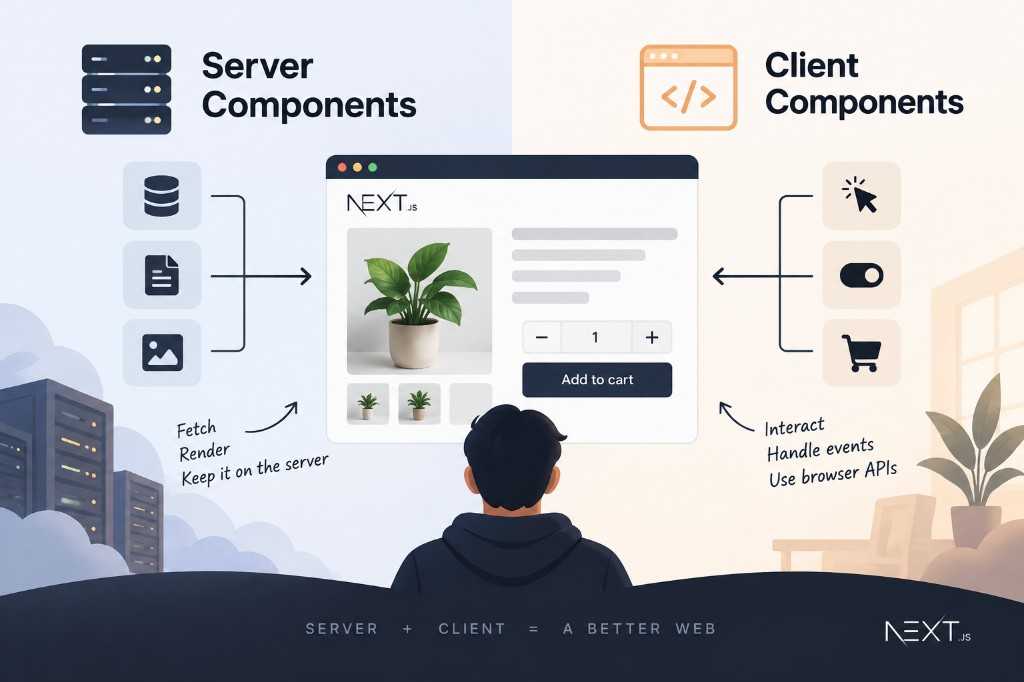
Server Components
In the App Router, components are Server Components by default. This makes them a good place to fetch data, query a database, access server-only resources, and render content for SEO.
export default async function ProductPage() {const product = await getProduct()return (<div><h1>{product.name}</h1><p>{product.description}</p></div>)}
Client Components
When a component needs interaction, add "use client" at the top.
"use client"import { useState } from "react"export default function Counter() {const [count, setCount] = useState(0)return (<button onClick={() => setCount(count + 1)}>Count: {count}</button>)}
Use Client Components when you need things like useState, useEffect, event handlers such as onClick, or browser APIs such as localStorage and window.
Use Them Together
Most real applications use both. For example, a product page can fetch the product on the server while keeping the Add to Cart button interactive on the client.
So the structure becomes:
ProductPage Server├── Product info Server└── AddToCart Client
export default async function ProductPage() {const product = await getProduct()return (<><h1>{product.name}</h1><AddToCart productId={product.id} /></>)}
"use client"export default function AddToCart({ productId }) {function handleClick() {// Add to cart}return <button onClick={handleClick}>Add to cart</button>}
Can a Client Component contain a Server Component?
Yes, but don’t directly import a Server Component into a Client Component. A common pattern is to pass the Server Component through children.
"use client"export default function Modal({ children }) {return <div>{children}</div>}
children is Server Component
export const _frontmatter = {"title":"Next.js: Server and Client Components","category":"Next.js","author":"Daniel Nguyen","tags":["#NextJS"],"date":"2026-09-23T00:00:00.000Z","thumbnailText":"Next.js"}
Tags
Share
