


Rate limiting controls how many requests a client can make within a specific period of time.
For example, an IP address may be allowed to attempt login only five times per minute.
1. What Is SlowAPI?
SlowAPI is a rate-limiting library for FastAPI and Starlette, adapted from Flask-Limiter. It uses the limits library to manage counters and enforce request limits.
2. How Does Rate Limiting Work?
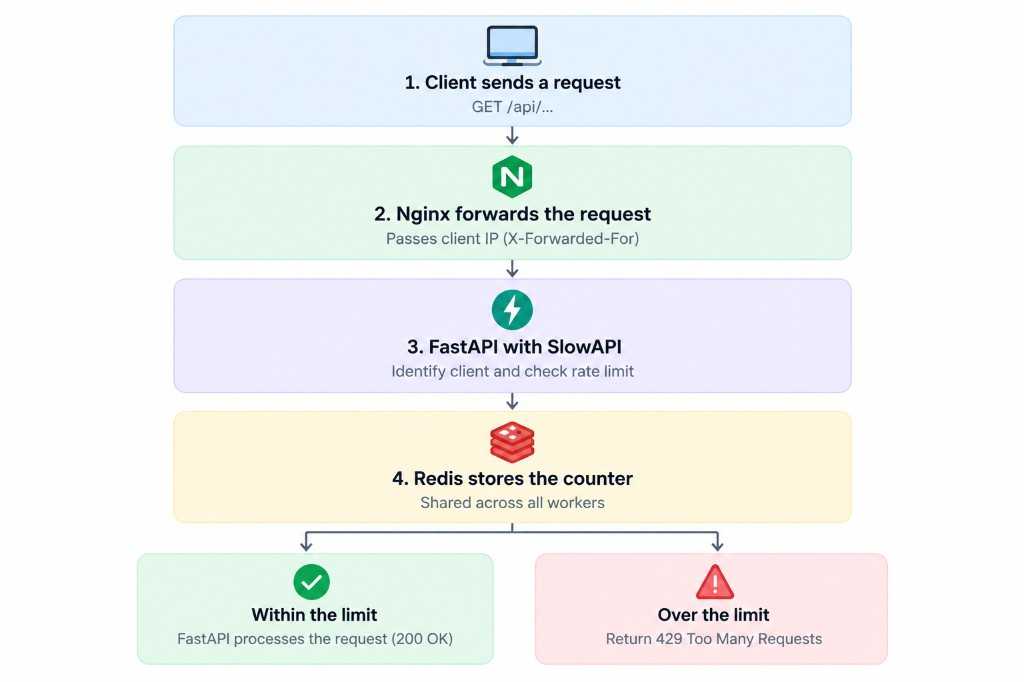
For every request, the rate limiter performs three steps:
- Identify the client: Usually by IP address or user ID.
- Count the request: Update the corresponding counter.
- Check the limit: Allow the request to continue or return HTTP 429.
For example, with a limit of 5/minute, the sixth request within the same limiting window will be rejected.
Counters are stored in a storage backend:
memory://stores counters inside the Python process.redis://stores counters in Redis, allowing multiple workers or servers to share them.
3. Install SlowAPI
Install the required libraries:
pip install slowapi redis
SlowAPI uses the limits library internally to manage rate limits.
a. Initialize the Rate Limiter
Create a shared limiter for your FastAPI application:
from fastapi import FastAPIfrom slowapi import Limiter, _rate_limit_exceeded_handlerfrom slowapi.errors import RateLimitExceededfrom slowapi.util import get_remote_addressapp = FastAPI()limiter = Limiter(key_func=get_remote_address,storage_uri="memory://",headers_enabled=True,)app.state.limiter = limiterapp.add_exception_handler(RateLimitExceeded,_rate_limit_exceeded_handler,)
Here’s what each option does:
key_func: Identifies the client. This example uses the client’s IP address.storage_uri: Specifies where request counters are stored.headers_enabled=True: Enables rate-limit response headers.app.state.limiter: Registers the limiter with the FastAPI application.add_exception_handler: Handles requests that exceed their limits.
In this example, memory:// is a simple choice for local development and experimentation.
b. Limit an Individual Endpoint
Use the @limiter.limit() decorator to restrict requests to a specific endpoint:
from fastapi import Request, Response@app.post("/login")@limiter.limit("5/minute")async def login(request: Request,response: Response,):return {"message": "Login endpoint"}
This endpoint allows five requests per minute per client IP.
SlowAPI requires the request: Request parameter to identify the client. If your endpoint returns a dictionary or Pydantic model rather than an existing Response object, add response: Response so the library can attach rate-limit headers.
Common limit formats include:
| Configuration | Meaning |
|---|---|
5/minute | 5 requests per minute |
100/hour | 100 requests per hour |
10/minute;200/day | Both limits apply simultaneously |
c. Set a Global Rate Limit
Besides individual endpoint limits, you can configure a default limit for the application.
For example, allow each IP address up to 200 requests per minute:
from slowapi.middleware import SlowAPIASGIMiddlewarelimiter = Limiter(key_func=get_remote_address,application_limits=["200/minute"],)app.state.limiter = limiterapp.add_middleware(SlowAPIASGIMiddleware)
You can exclude endpoints such as health checks:
@app.get("/health")@limiter.exemptasync def health():return {"status": "ok"}
