


Table Of Contents
If you are a developer building applications with LLMs, you do not need to understand every detail of how a model is trained. However, understanding how an LLM generates text, how tokens work, and how different types of models are used will help you build better AI applications.
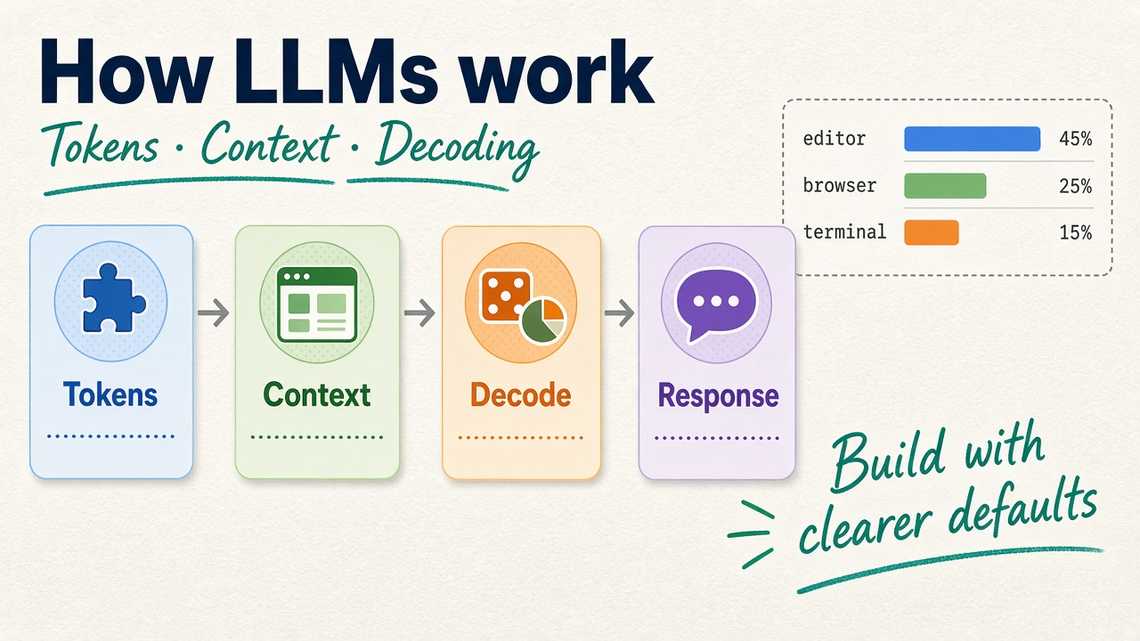
How Does an LLM Generate Text?
At a basic level, an LLM predicts the next token based on the tokens that came before it. The model assigns probabilities to possible next tokens and selects one according to a decoding strategy.
For example:
The developer opened the ...
The model might assign probabilities such as:
editor → 45%browser → 25%terminal → 15%laptop → 10%...
The selected token is added to the sequence, and the model repeats the process until it finishes generating the response.
Decoding Strategies
Greedy decoding always selects the token with the highest probability. It is simple and deterministic, but it can produce repetitive or less interesting results.
Beam search keeps several of the most promising sequences instead of following only one. It can be useful for some structured generation tasks, although it is less common for open-ended chatbot generation.
Sampling introduces randomness into the selection process. This allows the model to generate more diverse responses, but too much randomness can also produce low-quality or unexpected results.
Several parameters can control this behavior. Temperature controls how strongly the model favors high-probability tokens. Top-k limits sampling to the k most likely tokens, while top-p samples from the smallest set of tokens whose combined probability reaches a specified threshold.
In practice, these parameters are useful when you want to balance predictability, diversity, and creativity.
Tokens and Tokenizers
Tokens are one of the most important concepts when working with LLM APIs. A token is a small unit of text that the model processes. Depending on the tokenizer, a token can represent a complete word, part of a word, punctuation, or other characters.
A tokenizer converts text into tokens that can be represented as numbers and processed by the model.
There are three common approaches:
- Character-based: splits text into individual characters.
- Word-based: splits text into complete words.
- Subword-based: splits text into words or smaller pieces.
Modern LLMs commonly use subword-based tokenization because it provides a good balance between vocabulary size, efficiency, and the ability to handle new or uncommon words.
For developers, tokens matter because they affect context limits, API costs, latency, and model performance.
Context Size
The context window is the maximum amount of information a model can consider in a single interaction. It can include system instructions, conversation history, user messages, documents, and tool results.
For example:
System instructions+Conversation history+User request+Retrieved documents+Tool results↓Context Window↓LLM
A larger context window allows an application to work with more information, but it can also increase processing costs and latency.
Foundation Models vs. Instruction Models
Another important distinction is between foundation models and instruction/chat models.
A foundation model is trained primarily to learn general patterns from large amounts of data. A simplified example is a base language model that learns to predict the next token.
An instruction or chat model is further trained to follow human instructions and produce responses in a conversational format.
For example:
Foundation Model↓Instruction / Preference Tuning↓Instruction Model↓Chat Application
This distinction is important because developers usually want an instruction-tuned model when building a chatbot rather than a raw foundation model.
Prompt Structure
When working with chat-based LLM APIs, messages are typically separated by their roles. A common structure includes system/developer instructions, user messages, and assistant responses.
For example:
System:You are a helpful programming assistant.User:Explain React Query.Assistant:React Query is a library for...
The exact roles and API format depend on the provider and API version, but the idea is the same: developers provide instructions and context that guide the model’s behavior.
Clear instructions are especially important when working with smaller models because they may be less capable of interpreting ambiguous prompts.
Local LLM vs. Cloud API
Developers generally have two options when integrating an LLM: use a cloud API or run a local LLM.
A simple decision might look like this:
Personal project / Prototype↓Cloud APIPrivacy / Offline / Infrastructure Control↓Local LLM
There is no universal choice. The right approach depends on factors such as cost, privacy, model capability, latency, infrastructure, and expected traffic.
