


Dependency Injection (DI) allows a function to declare what it needs while another component provides it. This reduces coupling and makes applications easier to test and maintain.
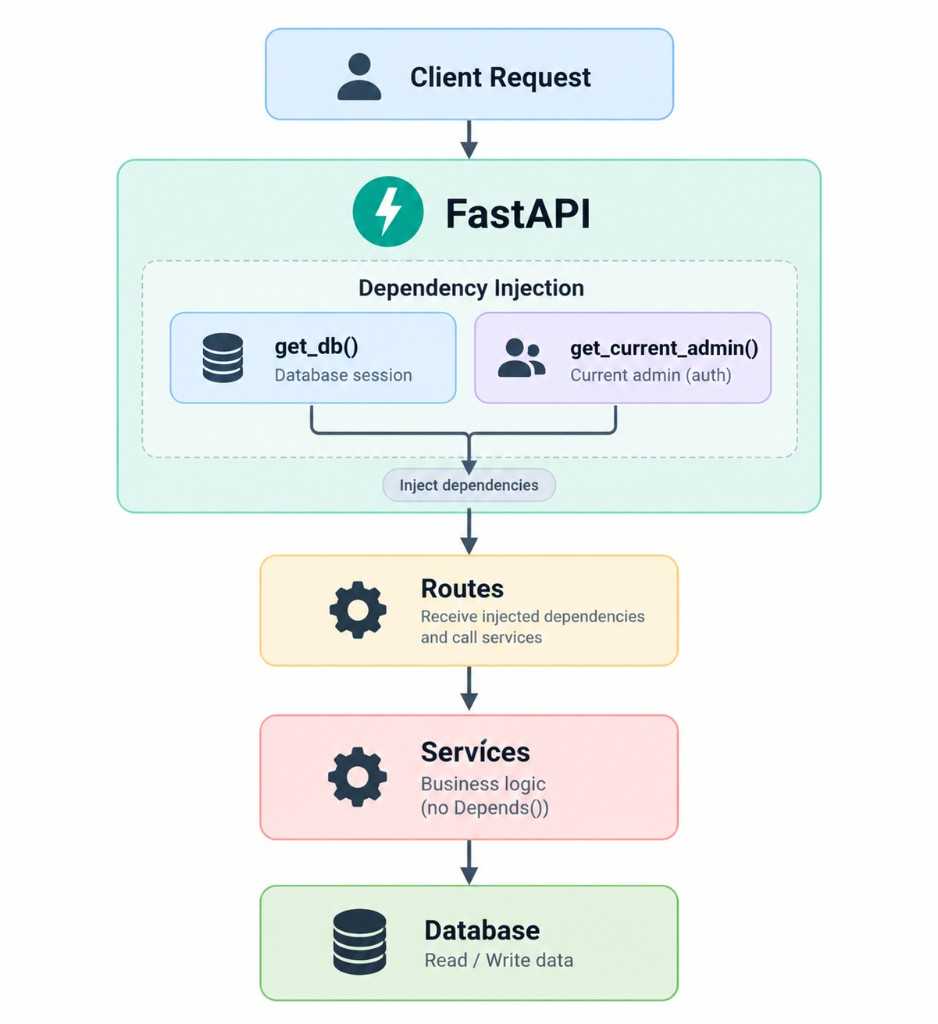
1. The Basic Idea
Without dependency injection, a route might create and manage its own database session:
async def get_plants():db = AsyncSessionLocal()try:# Query plants...finally:await db.close()
The route is responsible for both creating and cleaning up the database session.
With FastAPI’s dependency injection, the route declares its requirements using Depends():
from fastapi import Dependsfrom sqlalchemy.ext.asyncio import AsyncSessionasync def get_plants(db: AsyncSession = Depends(get_db),):# Query plants using db...
The route only declares what it needs. FastAPI resolves the dependency and manages its lifecycle according to how get_db is implemented.
This separates what a function needs from how that dependency is created.
2. Dependencies Can Depend on Other Dependencies
Dependencies can be composed to share common logic across routes.
For example, an authentication dependency may require a database session to retrieve the current administrator:
async def get_current_admin(request: Request,db: AsyncSession = Depends(get_db),) -> Admin:# Extract and validate the token# Retrieve the administrator from the database...
Here, get_current_admin depends on get_db.
A protected route can then use the authentication dependency:
@app.get("/api/admin/plants")async def get_admin_plants(admin: Admin = Depends(get_current_admin),db: AsyncSession = Depends(get_db),):...
FastAPI resolves the dependency chain automatically. By default, dependencies using the same callable and cache settings are reused within a request, so get_db can provide the same session to both dependencies.
3. Why Dependency Injection Is Useful
Loose Coupling
Routes don’t need to know how database sessions are created, and authentication logic can be reused across multiple endpoints.
Reusability
Common dependencies, such as database sessions, authenticated users, and pagination parameters, can be shared across routes.
Testability
Dependencies can be replaced during testing without modifying the route implementation.
For example, a test can override the database dependency:
app.dependency_overrides[get_db] = get_test_db
After testing, clear the override when appropriate:
app.dependency_overrides.clear()
This allows routes to use a test database instead of the production database. In a larger test suite, remove only the overrides your test added to avoid interfering with other tests.
Key Takeaways
Depends()declares a dependency that FastAPI resolves.- Dependencies can depend on other dependencies.
- DI separates dependency creation from business logic.
app.dependency_overridesmakes it easier to test routes with alternative implementations.
The key idea: A function declares what it needs, while dependency injection determines how those requirements are provided.
