

Table Of Contents
What?
It separates your system into core business logic and external world. Hexagonal Architecture isn’t about folders. It’s about protecting your business logic from chaos.
👉 Your app should work without NestJS, DB, or APIs
Think:
- Domain → pure logic (no framework)
- Application → use cases
- Ports → interfaces
- Adapters → implementations
- Infrastructure → framework glue
Recommended Folder Structure
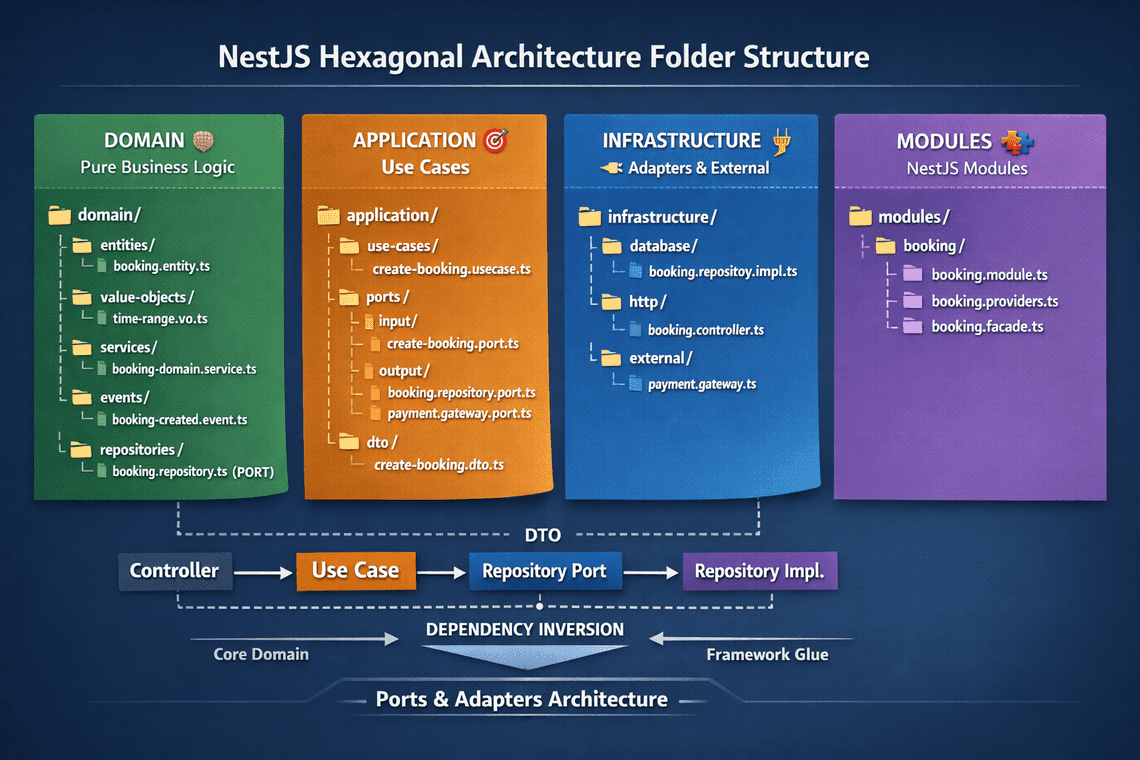
src/│├── domain/ # Pure business logic (NO NestJS)│ ├── entities/│ │ └── booking.entity.ts│ ││ ├── value-objects/│ │ └── time-range.vo.ts│ ││ ├── aggregates/│ │ └── booking.aggregate.ts│ ││ ├── services/│ │ └── booking-domain.service.ts│ ││ ├── events/│ │ └── booking-created.event.ts│ ││ └── repositories/ # PORTS (interfaces)│ └── booking.repository.ts││├── application/ # Use cases (business flows)│ ├── use-cases/│ │ ├── create-booking.usecase.ts│ │ ├── cancel-booking.usecase.ts│ │ └── get-availability.usecase.ts│ ││ ├── dto/│ │ └── create-booking.dto.ts│ ││ ├── ports/ # INPUT/OUTPUT PORTS│ │ ├── input/│ │ │ └── create-booking.port.ts│ │ └── output/│ │ ├── booking.repository.port.ts│ │ └── payment.gateway.port.ts│ ││ └── mappers/│ └── booking.mapper.ts││├── infrastructure/ # External world implementations│ ├── database/│ │ ├── prisma/│ │ │ ├── prisma.service.ts│ │ │ └── prisma.schema│ │ ││ │ └── repositories/ # ADAPTERS (implement ports)│ │ └── booking.repository.impl.ts│ ││ ├── http/│ │ ├── controllers/│ │ │ └── booking.controller.ts│ │ ││ │ └── dto/│ │ └── create-booking.request.ts│ ││ ├── messaging/│ │ └── kafka.producer.ts│ ││ ├── external/│ │ └── payment.gateway.ts│ ││ └── config/│ └── env.config.ts││├── modules/ # NestJS modules (composition root)│ └── booking/│ ├── booking.module.ts│ ├── booking.providers.ts # dependency injection bindings│ └── booking.facade.ts # optional orchestration layer││├── shared/ # Cross-cutting concerns│ ├── utils/│ ├── constants/│ ├── exceptions/│ └── base/│ └── entity.base.ts││├── main.ts # App bootstrap└── app.module.ts
Explained (Step-by-Step)
Request hits controller → controller calls use case → use case executes business logic via domain → interacts with repository interfaces → infrastructure provides implementations (DB/API). This keeps business logic independent from frameworks.
1. Request → Controller
👉 A user (or frontend) sends a request.
👉 Controller in NestJS receives it
Example:
POST /bookings
@Post()create(@Body() body: CreateBookingRequest) {return this.useCase.execute(body);}
What controller does: Validate input, Call use case, Return response, No business logic here.
2. Controller → Use Case (Application layer)
👉 This is the brain of the flow.
👉 Think: “What should happen when user books?”
execute(dto: CreateBookingDto) {// orchestrate everything}
What use case does: Coordinates steps, Calls domain logic, Calls repository (interface)
3. Use Case → Domain (Business rules)
👉 Domain decides what is valid or not.
👉 Think: “Is this booking valid?”
if (booking.conflictsWith(existing)) {throw new Error('Conflict');}
What domain does: Contains rules, Validates logic, No DB / no framework
4. Use Case → Repository (Interface / Port)
👉 Use case doesn’t know DB → it uses an interface.
👉 Think: “I need data, but I don’t care how”
this.bookingRepo.save(booking);
Important: This is just a contract. No implementation here
5. Infrastructure (Implementation)
👉 Real implementation lives here.
👉 Think: “How do we actually do it?”
@Injectable()export class BookingRepositoryImpl implements BookingRepository {async save(booking: Booking) {return this.prisma.booking.create(...);}}
What infrastructure does: DB queries (Prisma), API calls (payment, email), External systems